
Set Review: 11389 Project Hail Mary
There is a saying that reading a book before watching the movie based on it never goes as smooth as vice versa. For me there was never much choice about the matter in this particular case, because I had read Project Hail Mary long before the movie was even announced. (And enjoyed it to a great degree―it must still be among my top ten sci-fi novels, but that's a different story now.) Anyhow, the book spawned the recent movie, and the movie spawned the namesake set 11389 which found its way to my desk.
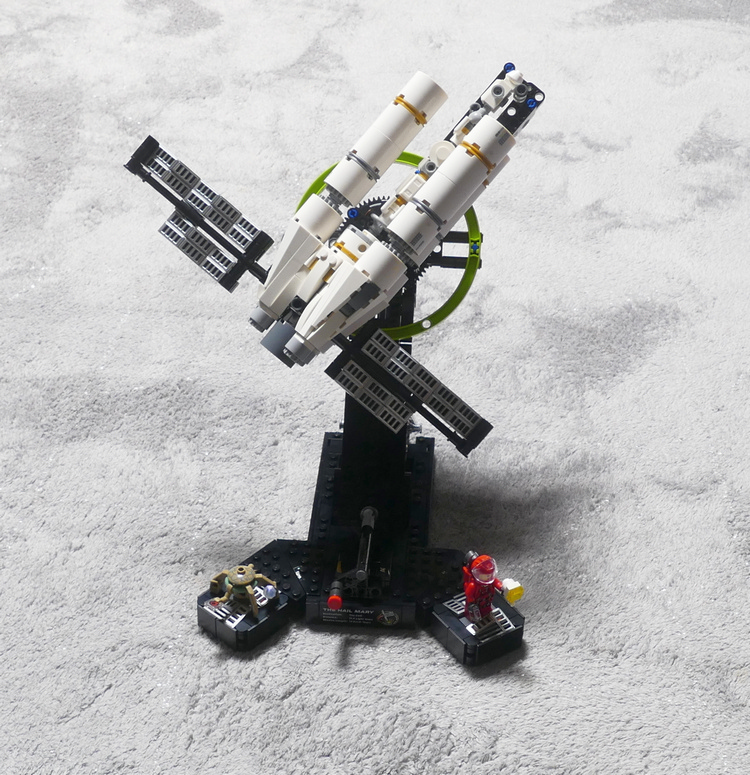
It is only fair that I, at this point, admit to my possible bias. I am a fan of sci-fi, and also a fan of LEGO sets that blend, or even camouflage, nice Technic mechanical functionalities in what otherwise seems like a static, shelf display model. The Project Hail Mary set ticks both boxes, obviously.
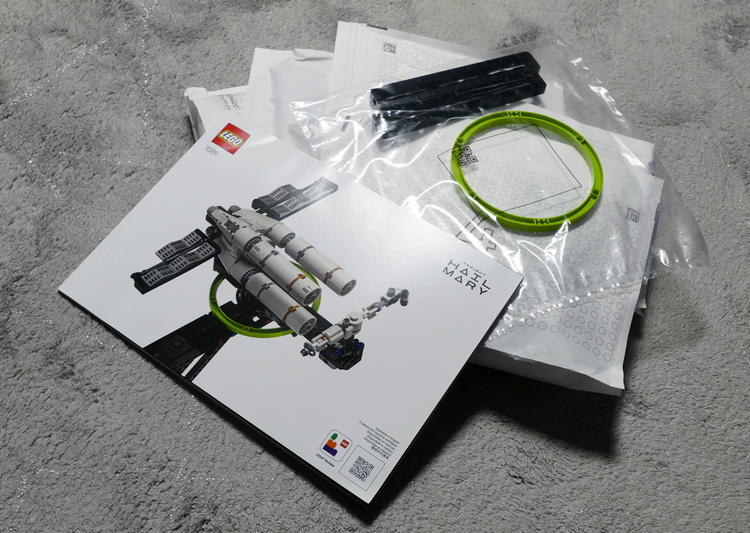
But―first things first. A medium-sized box contains six paper bags of parts (some containing sub-bags, as usual), a transparent one for a few large parts, and the instructions booklet. No surprises there, and in this department that's a good thing.
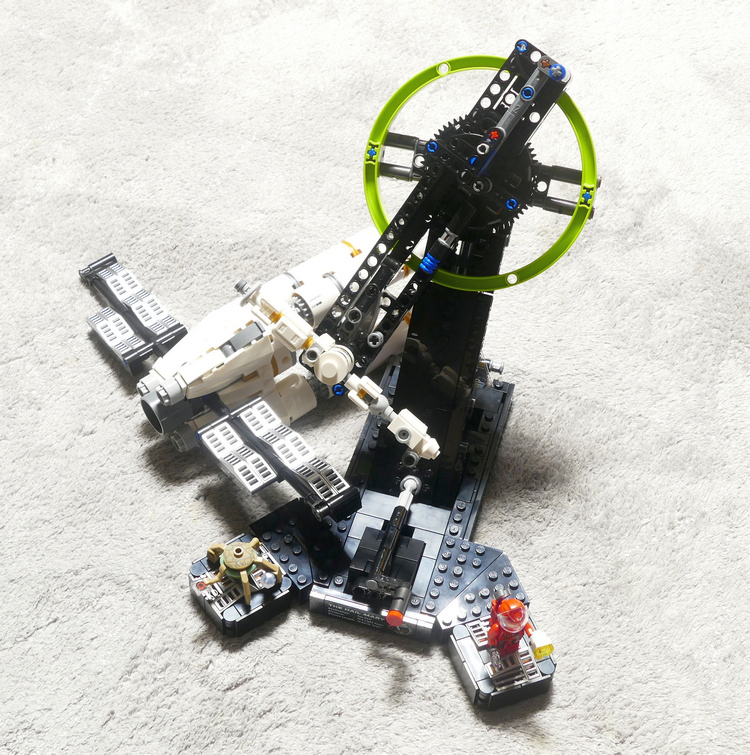
The building process begins with a little "pseudo-vignette" which depicts Ryland Grace, the main protagonist, meeting Rocky, the five-limbed alien he met on his mission―but let's not risk any further spoilers now. The little platform pads they stand on are surprisingly complex, i.e. their internal construction is quite surprisingly intricate, evidently all in efforts to make them visually appealing while allowing for tight connection through concealed clips. It's nice to see that neither Rocky nor Grace are empty-handed, but hold thingies related to the plot instead. The multi-segmented "wall" between them specifically follows the plot as well.

With these thingies complete, the focus shifts to the "main course": Grace's spaceship with its stand. The stand is actually built first, and is actually where the main fireworks begin, at least for me. To wit, the stand is pure Technic and has that elusive quality of letting one wonder what on Earth is it one is building and how is it supposed to work, only to have it all come together in the final steps when the full mechanical magic is revealed.
The spoiler risk here is lower, so here it goes: as described in both the book and the movie, the spaceship's living quarters can separate from the large drive section, while remaining tethered to it, in order to allow the artificial (centrifugal) gravity to be maintained by the entire structure spinning. And the kinematics of the stand in this case allow exactly that.

Rotating the front crank clockwise separates the living quarters from the drive, rotates them to a perpendicular position and then lets everything spin; rotating it counter-clockwise returns the quarters to the original position and original orientation, and then spins everything in the other direction. Even if you are a seasoned Technician, seeing it in action will be very, very satisfying.
The contraption behind the effect is quite clever and relies on a careful configuration of a rack, a knob gear, a turntable, and on their relative frictions. This kind of synchronized multiple-action mechanic is not something never before seen in Technic (e.g. vehicle outriggers come to mind), but it is somewhat rare and is, to the best of my knowledge, the first implementation in a structure that itself rotates. The mechanism is also very reliable and works smoothly regardless of the crank's rotation speed.

Other than that, the stand offers a little compartment where the "wall vignette" can be stored when Ryland Grace and Rocky are displayed in the front, and has a nameplate with the mission distance and duration.
Once the mechanically intricate stand is completed, we get to the spaceship itself. As already obvious from above, it is built in two segments―the living quarters and the propulsion section―which attach to two different pylons on the stand and can separate. The living quarters, by far the smaller segment, is a cascade of various parts strung across an axle to improve its sturdiness, which is higher than what the fragile-looking structure would otherwise suggest.
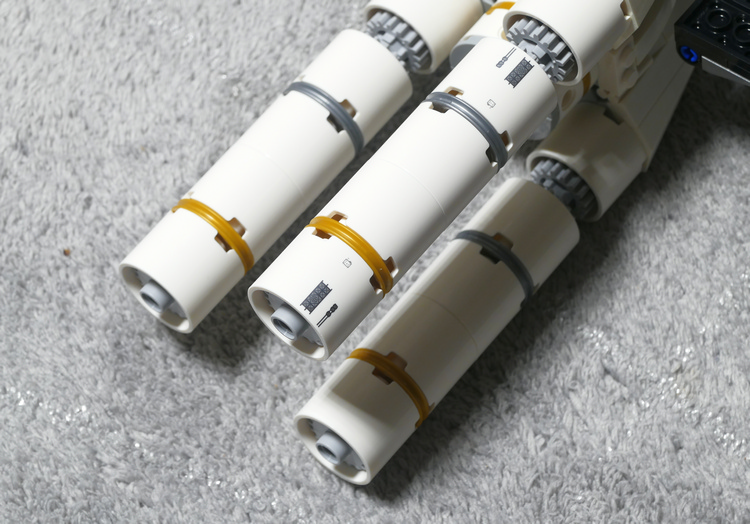
The spaceship's heavier propulsion part, however, is where one almost feels for the designer facing a particularly tough task of modeling the subtle shape and curvature of the spaceship's stern. Interesting building techniques come to light here, and not just SNOT approach, but some exotic angles too, e.g. by connecting two wings with their diagonal sides in the same plane with two pairs of hinge bricks. The three cylinder tanks, built around center axles just like the living quarters, are simpler. Two wavy cooling-solar panels complete the construction.
Altogether, the ship is certainly an interesting lesson in complex LEGO modeling, and is nowhere near traditional building, that is―from the bottom upward. The experience is closer to, for example, modern Technic, with components being built and added from inside out, at unusual angles.
All these things considered, I would classify the set difficulty as moderate. There are a dozen or so steps that require some skill, e.g. where multiple Technic pins connect in different directions, or components are assembled at special angles―but there are none that require extreme care either. Technic parts can be somewhat intimidating for builders with limited experience, but the instruction booklet does a good job of not overcompressing too many actions into single confusing steps.
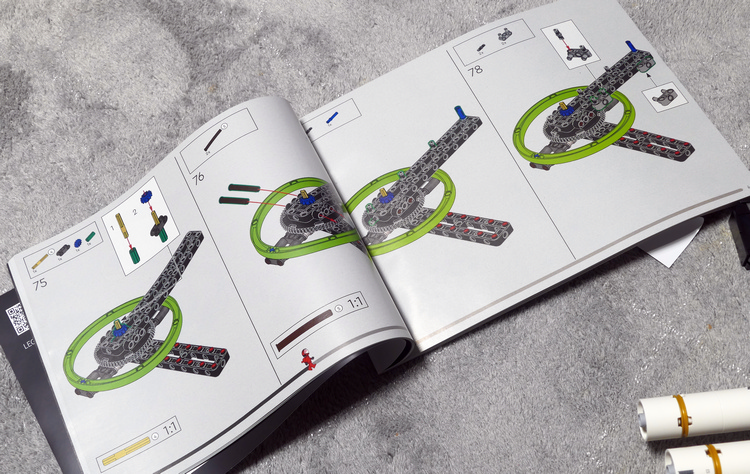
Speaking of which, I encountered two building steps which, to my mind, would have made more sense if they were done in the reverse order. And, while on the topic of instructions, it was nice to see them annotated with comments, mentioning which segments relate to which points in the plot. It's just a small detail, but it brings smile to one's face.
In my opinion, no set is sacred; none should be above the notion of being disassembled and reused for something else. Reusability is the very lifeblood of LEGO, so even though this set was possibly intended for display on a shelf or a mantlepiece, as AFOL's we must consider it from the parts supply point of view. And in this regard, 11389 is interesting in several ways.
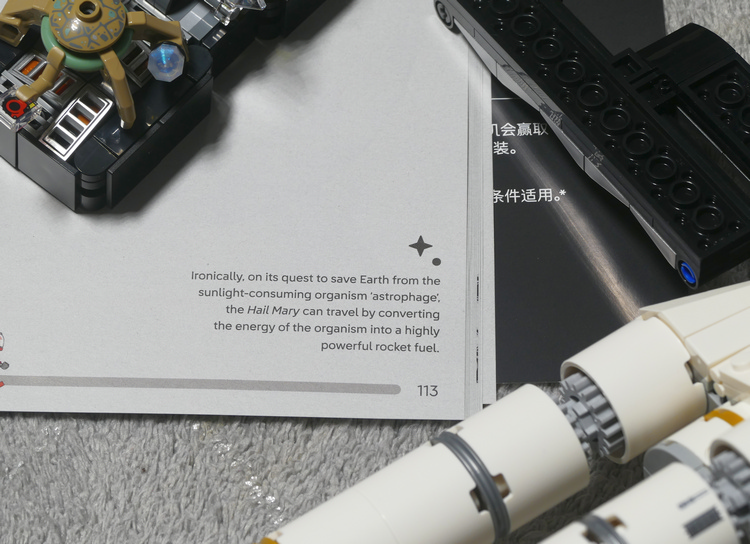
Firstly, as is rather obvious right from the first glance, this is not a set to expect lots of generic raw building material from. The spaceship supplies fifteen white rims (known also as round bricks with axle hole, of which six have tiny prints), which can turn out quite useful for some specific types of projects. A pearl-trans-clear rock is nice, too: actually there are two, counting also the spare one. Ryland Grace has a hair to wear when he removes his helmet, there are four pairs of nice black 6x4 wings, a separator is always a nice addition, too, and forty (!) metallic silver slopes even nicer.
But, where Project Hail Mary actually delivers more than one would think are Technic parts, mostly "hidden" in the stand. As a Technic fan, I'm always delighted to have one more turntable, as well as one more large ball joint along with its receptacle. The set also contains a 5-stud-long axle connector which has only started circulating last year, which can be useful in many mechanical contexts.
As for the heavier parts, even though the 19x3 Technic frame is no longer rare, having two of them here is a welcome addition, and the same applies to the 15L wide Technic ring, which has been seen only twice before in lime color.

Ryland Grace's red spacesuit is unique for this set, as is the dish on the top of Rocky's "minifig", together with a few other printed parts. No stickers in this set; each and every label is printed.
Considering everything said, it is easy to conclude that my overall opinion of this set leans toward positive. It looks good, it is fun to build, it is easily recognizable to anyone who saw the movie, and it has that impressive mechanical feature of separating the living quarters from the propulsion stage of the ship and reconnecting it, all while mesmerizingly spinning. Creative builders will certainly appreciate multiple interesting parts that 11389 brings.
Of course, nothing's perfect, and if one wanted to nitpick, one could argue that a set of over 800 parts should offer more than one mechanical functionality, regardless of how impressive that single one may be. I guess playability also is not one of this set's strengths, even though LEGO themselves indirectly point that out with the 18+ age rating.
For sets based on a franchise or a work from the real world, it is often said their primary buyers will be the fans of that specific work, especially those who like LEGO anyway. In this case, I would dare say this would be an interesting set to a wider group than "just" sci-fi and Project Hail Mary fans: regardless of the book and the movie, its mechanical marvel is something out of the ordinary, and even when you feel you have had enough and decide to disassemble it, some interesting parts will become available on your desk.
Number of parts: 830
Figs: 2 (Grace and Rocky)
Mech.features: Ship separates and recombines while spinning
Age rating: 18+
We thank LEGO for sending us this set. All the opinions stated above are however our own.

33728